X1 name registry
X1ID documentation
One handle — @you — that resolves to your address across X1, Solana, Ethereum, and Bitcoin. Claim it once; it's yours forever. Try the resolver, then jump into the docs.
Try it out
Verified responsesReal, verified responses from X1 mainnet — copy each request and run it yourself (no wallet, no key). The REST tabs are plain GETs on https://api.x1id.io; the SDK reads chain state directly. Writes (register, subnames, gifts) are signed transactions — see the API reference.
curl https://api.x1id.io/resolve/x1{ "input": "x1", "name": "x1", "namespace": "handle", "owner": "E2cELMtby3YY…9pEk2iUq6", "tokenized": false, "verification": "owner"}
X1ID is live on X1 mainnet — claim your handle at app.x1id.io. The registry is a public on-chain program you can verify yourself; see Trust & transparency for exactly how.
Start here
Use your handle
Identity & trust
Reference
- Resolve APILook up the address a handle points to — read-only, public.
- MCP serverResolve handles and prepare unsigned instructions for AI agents.
- ContractsThe registry program address on X1 mainnet, and how to verify it.
- Buy & sell handlesThe built-in marketplace and how listings work.
- Invite friendsShare your referral link; get credited on-chain.
What X1ID is
A wallet address is 44 unreadable characters, and one wrong character sends funds nowhere. X1ID replaces it with a name you can read and share: register @you once and people pay it instead of copying an address, apps show you as @you instead of raw base58, and a single handle resolves to the right address on whichever chain the sender is on. It's permanent — no renewals, no expiry, on a standard registration (an optional lease-to-own path exists for spreading the cost) — and it carries a profile you own, so a wallet can finally prove who it belongs to. Start with Why get an X1ID, then claim your handle.
@you is a handle, not a domain. X1ID (@jack) and X1NS (jack.x1) are complementary — different shapes for different jobs, and many people own both. See how they fit together.
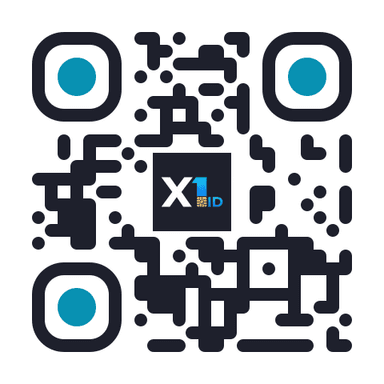
Every handle gets a shareable payment code. Someone points a wallet at it and pays straight to @you — no copied address, no wrong-chain mistakes. The code carries your primary chain and resolves live.
Add pay-to-handle